# Phase

## 1. Extra Phase

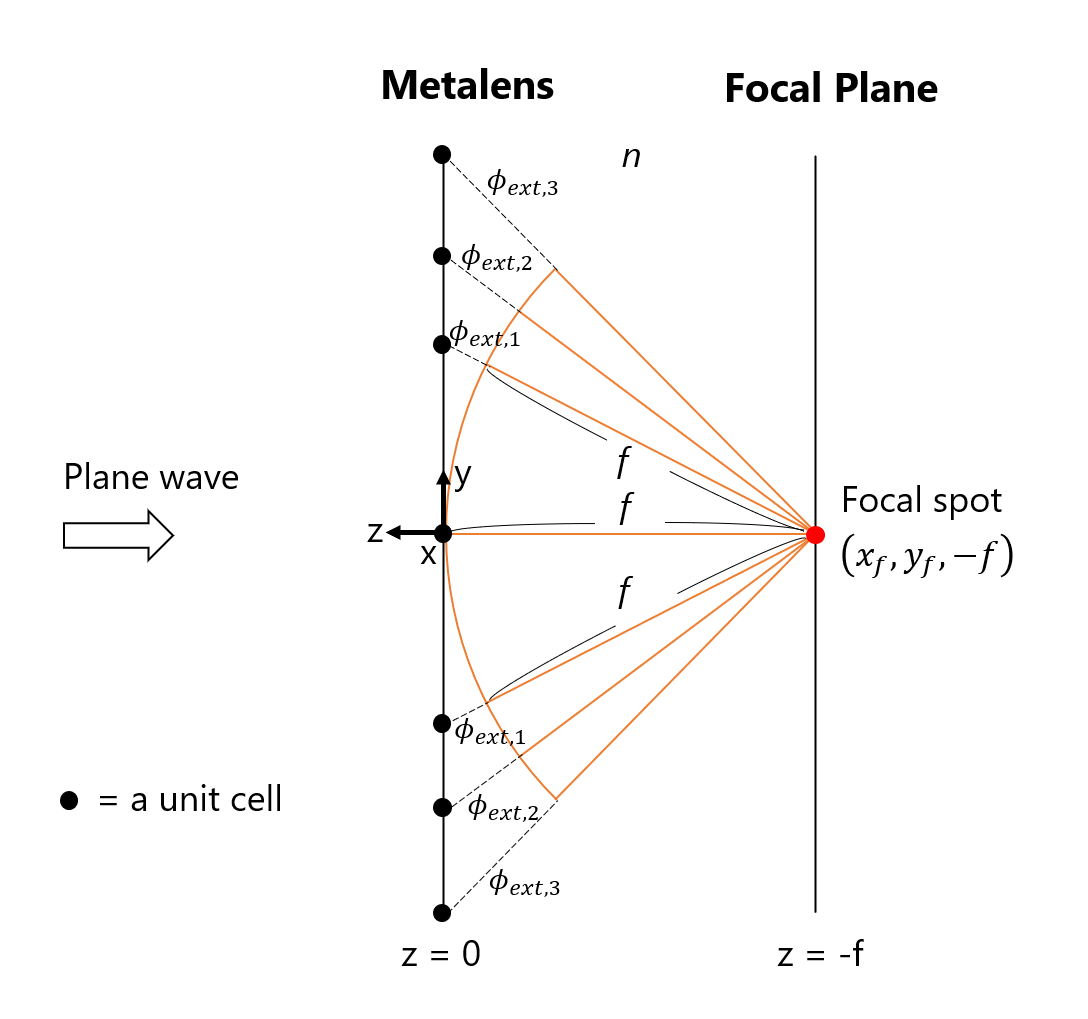
We use the term “extra phase (𝜙<sub>ext</sub>)” to refer to the phase defined by:

$$
𝜙\_{ext}(𝑥,𝑦) = {2𝜋n\over𝜆\_o}  \lbrace\sqrt{(x-x\_f)^2 +(y-y\_f)^2+f^2}-f\rbrace
$$

, where n: refractive index of the transmitted medium, 𝜆<sub>o</sub>: wavelength in vacuum, (x<sub>f</sub>, y<sub>f</sub>): x and y positions of focal spot, and f: focal distance. Extra phases for several unit cell positions are described in the figure below; where each unit cell is a source of a spherical wave. Because of extra phase, these spherical waves cannot superpose constructively at the focal spot. This indicates that unit cells must introduce different amounts of phase shift to the incident wave, a plane wave, to cancel the effect of extra phase and produce constructive interference at the focal spot.

<figure><img src="/files/lo7SWdraWTCjJ7qNao6e" alt="Minsu Oh, Simple Metalens" width="563"><figcaption></figcaption></figure>

## 2. Unit Cell Phase

### 2.1. Definition

We define the term “unit cell phase (𝜙<sub>uc</sub>)” such that it is equal to the phase of the scattering parameter S<sub>21</sub> of the unit cell, regardless of which phase sign convention is used. In other words, unit cell phase is the phase of S<sub>21</sub>.&#x20;

### 2.2. Sign Convention

Depending on the computation method, the phase of S<sub>21</sub> can have different signs for the same unit cell: +90 deg or -90 deg, for example. The difference in signs arises not because of some physical differences of waves but purely because of a mathematical choice of whether the wave phase should increase from a point on the wave generated earlier in time to a point generated later in time or the other way around.

**Convention A**

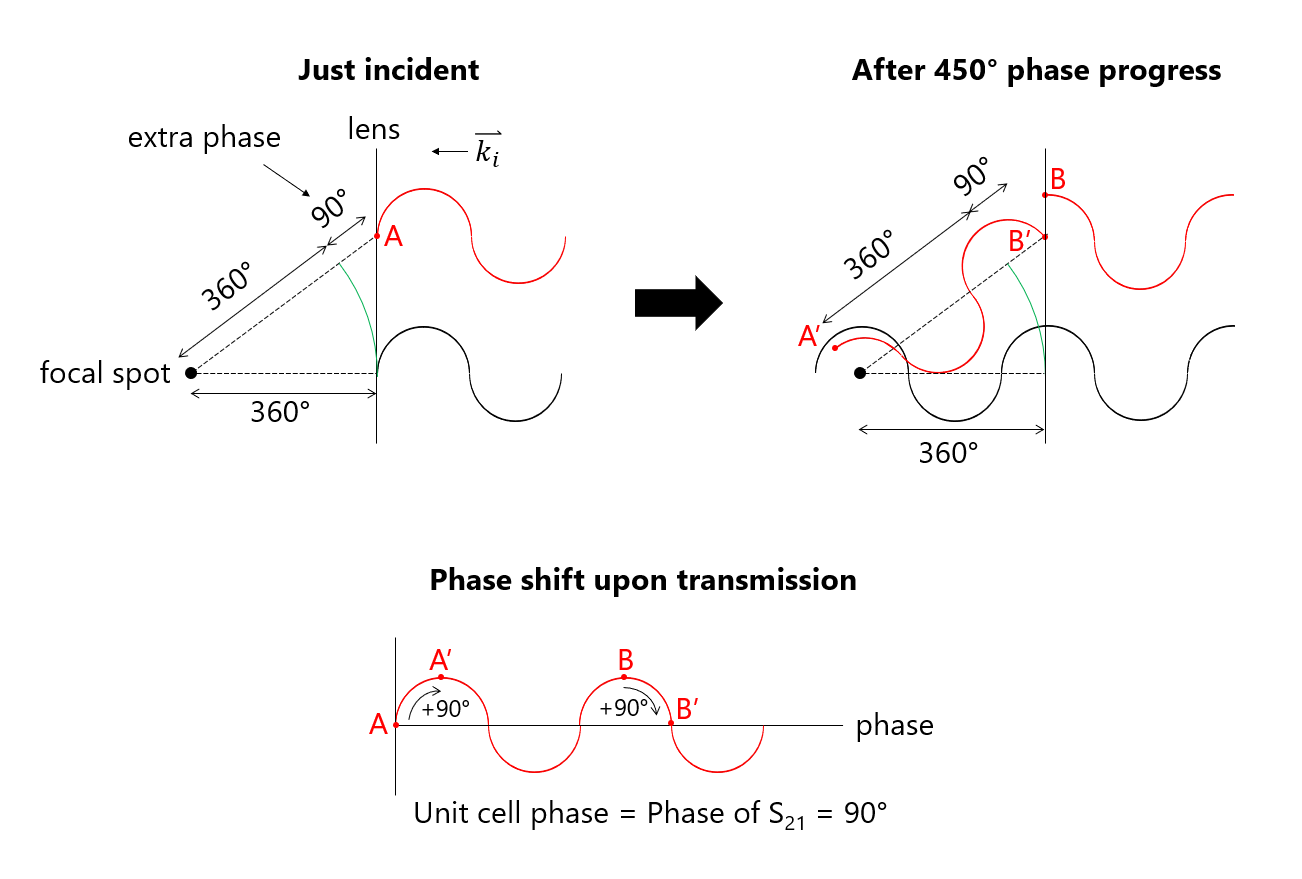
In this convention, a point on the wave generated earlier in time has a smaller phase, and a point generated later in time has a larger phase. For example, in the below image, a plane wave is propagating on right side of the lens towards the left. The foremost point —say, point A in the red wave, which was generated earliest in time, is at the phase of zero. The part of the wave that will arrive at the lens later in time will have a larger phase: for example, the point B in the red wave is at the phase of 450 deg. Thus, the unit cell phase for the red wave is +90 deg. For an ideal metalens, in this convention, the unit cell phases at all unit cell positions must be equal to their corresponding extra phase (𝜙<sub>uc</sub> = 𝜙<sub>ext</sub>).

<div align="center"><figure><img src="/files/7SAZIJNdQklfXf8rbUuE" alt="" width="563"><figcaption><p>Phase shift to focus light (sign convention A). A plane wave is incident from the right side of the lens. Diffracted waves, spherical waves, at the unit cells superpose at the same phase, +90° in the figure, at the focal spot. A and A’: phases of incident and transmitted waves, respectively. B and B’: phases of incident and transmitted waves, respectively.</p></figcaption></figure></div>

**Convention B**&#x20;

The other sign convention is based on the choice where a point on the wave generated earlier has a larger phase and a point generated later has a smaller phase. Thus, the phase increases as you move along the direction of propagation — *this convention is commonly used in analytical analyses of wave phenomena*. The unit cell phase for the red wave in the above image will be -90 deg. For an ideal metalens, in this convention, flip the sign of the extra phase and that value must be equal to the unit cell phase (𝜙<sub>uc</sub> = -𝜙<sub>ext</sub>). The term "-𝜙<sub>ext</sub>" here is also referred to as "*target phase*" in some literature (𝜙<sub>target</sub> = -𝜙<sub>ext</sub>).

{% hint style="success" %}
&#x20;In SMD PRO, users can assign a sign convention for their unit cell.
{% endhint %}

## 3. Target Phase

Ideally, the unit cell phase is desired to be equal to the target phase, assuming the phase sign convention B above. When designing a metalens, you would arrange unit cells so that the profile of unit cell phases is as conformal to the target phase profile as possible across the lens. However, [a unit cell would impose a single value of phase shift to the incoming wave](#user-content-fn-1)[^1]. Thus, a metalens cannot create a phase response perfectly conformal to the target phase profile, unless the unit cell period is \~0. This is illustrated in the image below, where the target phase profile, which is a surface given as a function of both x and y positions over the lens, is shown as a curve for simplicity. Notice that the deviation between the target phase and unit cell phase is larger at the edge of the lens and smaller at the center of the lens.

<figure><img src="/files/2skGJf6qMqgVO3L8h07U" alt=""><figcaption><p>Phase profiles with two different unit cell periods.</p></figcaption></figure>

Regarding the [extra phase equation](#id-1.-extra-phase) above, a higher numerical aperture (NA) leads to a higher extra phase, which then results in a steeper target phase curve. The image below compares two lenses with different NAs, where the aperture size and the unit cell period are equal between the lenses. Notice that the lens with a higher NA suffers more deviation between the target phase and unit cell phase, which may lower the lens performance. Sometimes, the Nyquist criterion, which relates the NA to the unit cell period, is mentioned of in the literature as a metric to determine the unit cell period needed. However, the criterion is not a necessary condition for the metalens (or any diffractive optical elements) to focus light.

<figure><img src="/files/7SFFkkvP7NJElRWMPLtV" alt=""><figcaption><p>Phase profiles with two different numerical apertures.</p></figcaption></figure>

[^1]: We are are ignoring the phase disturbance at the boundaries of the unit cell. &#x20;


---

# Agent Instructions: Querying This Documentation

If you need additional information that is not directly available in this page, you can query the documentation dynamically by asking a question.

Perform an HTTP GET request on the current page URL with the `ask` query parameter:

```
GET https://simplemetalens.gitbook.io/docs/smd-pro/topical-discussions/phase.md?ask=<question>
```

The question should be specific, self-contained, and written in natural language.
The response will contain a direct answer to the question and relevant excerpts and sources from the documentation.

Use this mechanism when the answer is not explicitly present in the current page, you need clarification or additional context, or you want to retrieve related documentation sections.
